

Cambios en la normativa NTS: ¿Qué instalaciones deberán cumplir ahora el código de red?
The electricity sector is approaching a turning point. The entry into force of Royal Decree 88/2026 and Order TED/82/2026 significantly expands the scope of the Technical Supervision Standard (NTS) and modifies the requirements applicable to numerous installations connected to the grid.
As of May 2026, projects that were previously outside the scope of these obligations —from certain self-consumption modalities to energy storage installations— will be required to demonstrate their behavior in relation to the power system through technical studies, simulations, and certification processes in accordance with the procedures established in the NTS.
This regulatory change takes place in a context of rapid expansion of renewable energy, self-consumption, and energy storage systems, which are transforming the operation of the electricity system. To ensure grid stability in this new scenario, the regulatory framework strengthens the technical supervision mechanisms applicable to installations connected to the system.
End of NTS exemptions for self-consumption installations
Until now, certain self-consumption installations were exempt from complying with the requirements established in the NTS.
These mainly included self-consumption installations without surplus (zero export) and installations with surplus capacity ≤ 15 kW located on developed land.
With the new regulation, these exemptions disappear. As a result, installations that were not previously required to demonstrate compliance with the grid code now fall within the scope of the NTS.
This means that a greater number of projects will need to undergo technical verification processes and behavioral analysis under different power system conditions.
NTS and energy storage: new regulatory requirements
Another significant change is the explicit inclusion of energy storage installations within the scope of the NTS.
These systems can operate both in absorption mode, when charging, and in generation mode, when discharging. According to the new regulation, they must demonstrate compliance with applicable technical requirements in both operating modes.
Until specific regulation for storage is developed, the framework refers to the requirements applicable to power generation modules, i.e., the technical criteria currently required for renewable generation installations connected to the grid.
The growing role of storage —especially in combination with renewable generation— makes it necessary to verify that these systems adequately contribute to grid stability.
This new context introduces additional needs for dynamic modeling and simulations to ensure compliance with the grid code, particularly in projects integrating batteries or hybrid systems.
Additional modifications
The regulatory update also introduces the concept of significance for installations located in the Non-Peninsular Electrical System (SENP).
Likewise, certain “Type A” installations must demonstrate compliance with technical requirements such as fault ride-through capability, a key aspect to ensure system stability under disturbances.
What do these changes imply for developers and engineering firms?
The direct consequence of these regulatory changes is that a larger number of installations will need to demonstrate compliance with the grid code in accordance with the NTS.
This introduces new technical requirements in the development of energy projects, including:
- Analysis of the dynamic behavior of installations
- Grid code compliance simulations
- Verification of system response under disturbances
- Validation of control systems
- Certification processes associated with the NTS
One of the main risks for projects lies in the lack of awareness of the new regulatory requirements and certification procedures. This may lead to delays in grid connection processes, iterations with the system operator, additional studies, and increased project development costs.
Therefore, it is essential to assess from the early stages of the project whether the installation will need to comply with NTS requirements.
NTS studies: a key tool to demonstrate grid code compliance
NTS studies enable the analysis of the behavior of electrical installations under different system conditions and demonstrate compliance with the requirements established in grid codes.
These studies typically include:
- Static and dynamic simulations of installation behavior
- Fault ride-through response analysis
- Control system validation
In many cases, these analyses require tests and simulations mandated by the NTS to verify installation performance under different power system conditions.
In this context, working with entities experienced in dynamic behavior analysis and grid code compliance verification is key to avoiding delays in project development.
How CIRCE can help
CIRCE has extensive experience in grid code compliance studies and dynamic behavior analysis of electrical installations.
Additionally, CIRCE is accredited by ENAC under the UNE-EN ISO/IEC 17025 standard to perform complementary simulations within the NTS framework, reinforcing its capability to support verification processes with technical rigor and reliability.
Its capabilities include:
- Simulations for NTS and grid code compliance
- Dynamic behavior analysis of energy storage systems (BESS)
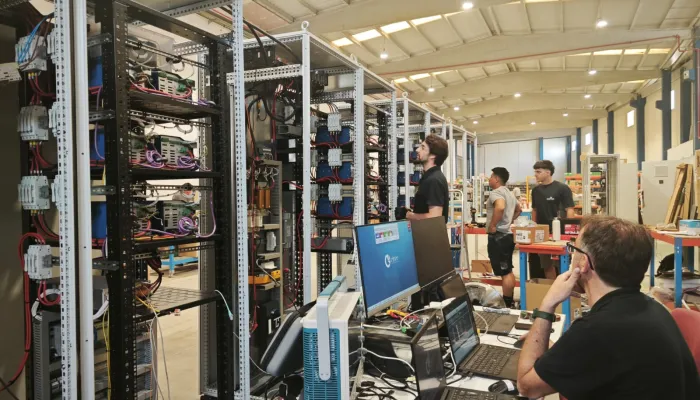
- Hardware-in-the-Loop (HIL) testing to support certification processes of Power Plant Controllers (PPC)
- Development of advanced control strategies for integrating renewable generation and storage into the grid
Thanks to these capabilities, CIRCE supports developers, engineering firms, and manufacturers in adapting to new regulatory requirements.
Will your project need to comply with the NTS?
Regulatory changes are expanding the number of installations required to demonstrate grid code compliance. Assessing these requirements from the early stages of a project helps avoid connection delays and reduces technical risks associated with certification processes.
Contact the CIRCE team to find out how to adapt your project to the new NTS requirements.
Latest news