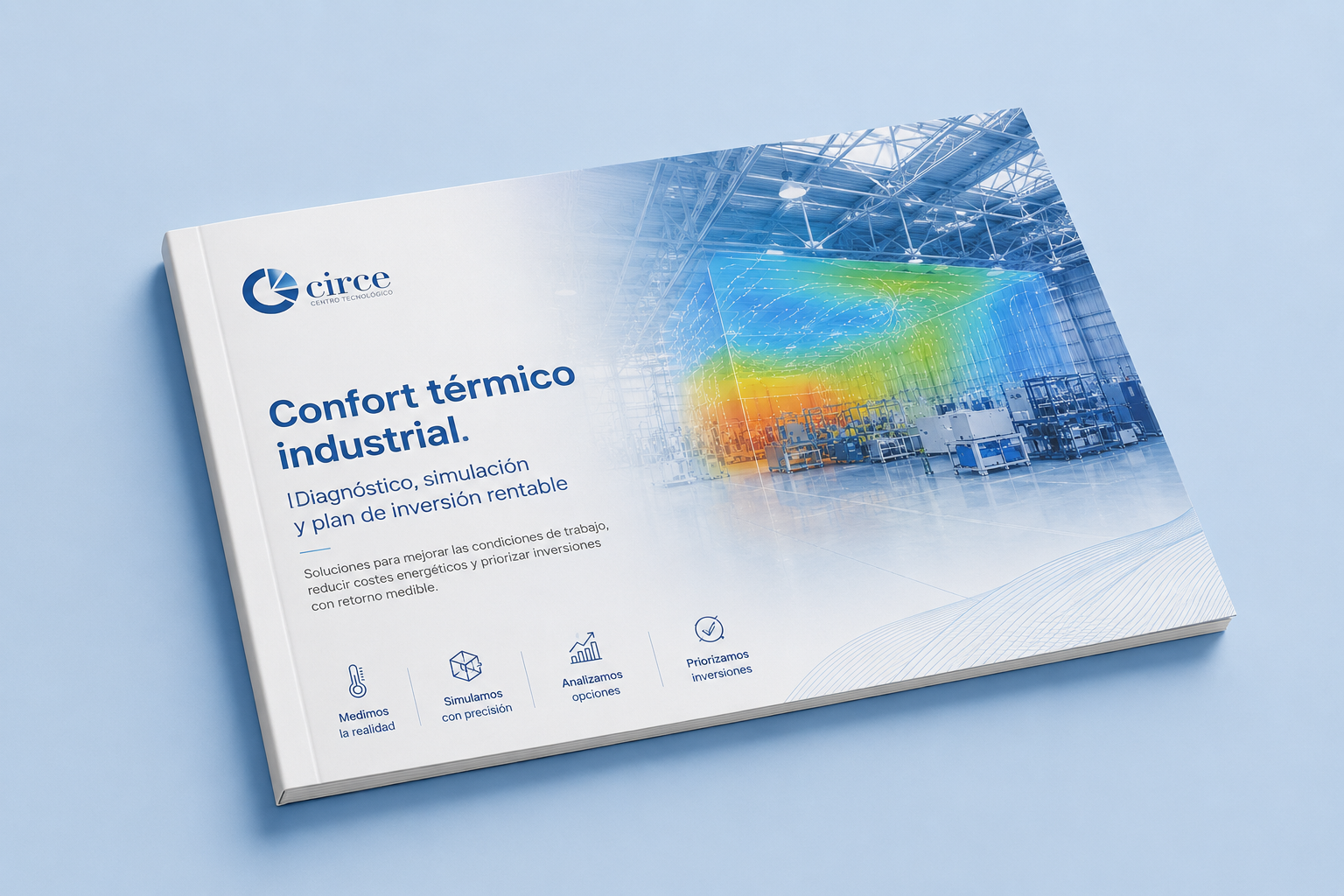


Thermal Comfort Assessment in Industrial Facilities Through Measurement and CFD Simulation
Improve thermal comfort, reduce energy costs and support investment decisions through measurement, simulation and independent technical analysis.
Description of the service
At CIRCE, we understand that thermal comfort and temperature conditions directly affect worker wellbeing, operational efficiency and energy consumption. Our approach combines field measurements, technical analysis and CFD simulation to identify the root causes of thermal comfort issues and determine the most effective improvement actions.
Environmental conditions inside industrial facilities can change over time. Production lines, equipment expansions, process modifications or increased occupancy may alter the thermal behaviour of a building.
The consequences may include excessive temperatures, poor ventilation, worker discomfort, increased energy consumption and uncertainty regarding necessary investments.
What Is an Industrial Thermal Comfort Assessment?
An industrial thermal comfort assessment is a technical service designed to understand the actual environmental conditions within a facility and identify the factors affecting workers’ wellbeing and workplace comfort.
The study combines on-site measurement data with advanced simulation tools to analyse variables such as temperature, humidity, air velocity, ventilation effectiveness, comfort indices such as PMV and PPD, and the performance of HVAC systems.
The objective is not simply to collect data. It is to understand why problems occur and determine the most effective and economically viable corrective actions.
Does Your Facility Experience Any of These Issues?
Many industrial companies face situations such as:
- Excessively high temperatures, particularly in summer.
- Complaints from employees regarding thermal discomfort.
- Uncomfortable or poorly distributed airflows.
- Areas with noticeable temperature differences.
- High energy consumption associated with cooling or ventilation systems.
- Concerns regarding compliance with occupational health and safety regulations.
- Difficulties identifying the origin of thermal comfort problems.
- Planned facility modifications or expansions.
- Investment decisions requiring technical validation.
In many cases, the root cause is not immediately visible through on-site observation alone. It may be related to how heat loads evolve, how air moves throughout the facility or how HVAC systems interact with production processes.
What Does the Service Include?
Our service combines measurement, simulation and economic analysis to support informed decision-making.
Technical Assessment
We begin with a site visit to understand the actual operating conditions of the facility, identify critical areas and collect all information required for the analysis.
This may include plant layouts, ventilation and air-conditioning systems, heat generation sources, operating processes and historical incident records.
Digital Modelling of the Facility
We develop a digital model of the facility that incorporates dimensions, equipment, HVAC systems, thermal loads, environmental conditions, occupancy and production processes.
This model accurately reproduces the facility’s behaviour under real operating conditions.
CFD Simulation
Computational Fluid Dynamics (CFD) simulation allows us to visualise how air circulates throughout the facility.
This technology makes it possible to identify heat accumulation zones, thermal stratification, uncomfortable air currents, inefficient ventilation areas, regions with limited air renewal and other issues that are difficult to detect through direct observation.
Technical and Economic Evaluation
Each improvement alternative is assessed considering:
- Capital investment (CAPEX).
- Operating costs (OPEX).
- Energy consumption.
- Return on investment.
- Expected thermal comfort improvements.
- Available grants and incentives.
- Potential eligibility for Energy Saving Certificates (CAEs).
The goal is to prioritise the actions that generate the greatest impact.
Request an Environmental Conditions Assessment for Your Industrial Facility
Understanding how environmental conditions affect thermal comfort is the first step towards improving worker wellbeing, reducing operating costs and investing with confidence.
The CIRCE team combines field measurement, CFD simulation and technical analysis to help organisations make data-driven decisions.
We do not provide assumptions based solely on past experience.
Our methodology integrates on-site measurements, CFD modelling, energy analysis and economic evaluation to support robust investment decisions. The result is a clear and objective roadmap to improve thermal comfort, energy efficiency and operational productivity.
Share your challenge with us!
Value proposition
Data-Driven Investment Decisions
Invest with confidence, not intuition.
Before investing in new ventilation, cooling or climate control systems, we provide objective evidence to support the most effective actions and maximise the technical, operational and economic return.
Simulate Before You Act
Visualise system behaviour before executing investments.
CFD simulation allows organisations to evaluate different scenarios and understand their impact before implementing any modifications, reducing risks and avoiding unnecessary costs.
Independent Technical Analysis
The best solution for your facility, not for a supplier.
Our analysis is completely independent. We do not commercialise equipment or installations, allowing us to provide objective recommendations focused exclusively on the needs of your facility and business goals.