

Beyond the Chatbot: Applications of AI in Industry

In our previous blog post, 'From Data to Decision', we described the growth that AI has experienced in recent years and what is expected in the years ahead. It is clear that this technology has grown at an unstoppable pace, with new developments emerging daily across the leading applications: ChatGPT, Gemini, Midjourney, and others.
Just a few days ago, Elon Musk launched the new version of xAI's artificial intelligence: Grok 3. Billed as the 'most intelligent in the world' — though available only in a paid version — it introduces new features such as the ability to reason while concealing its reasoning model.
Artificial intelligence: far more than a chatbot
The true revolution of AI is not limited to content generation such as text or images; its greatest potential lies in its application to industry.
At CIRCE, we know that this technology goes far beyond a conversational assistant, and we incorporate Artificial Intelligence into services applied to industry — such as process optimisation and cost reduction — always in line with our mission to drive sustainability.
From theory to practice: examples of AI driving industry forward
Artificial Intelligence applications make it possible to improve operational efficiency, predict errors, and anticipate problems before they occur. At CIRCE, we have set out the areas in which we are working with Artificial Intelligence to generate a tangible impact:
Predictive maintenance and energy optimisation
In the industrial sector, we have all encountered situations involving losses caused by unexpected machinery downtime. Artificial Intelligence has significant potential in these cases, as it helps to anticipate failures and carry out preventive maintenance.
For example, some companies are using IoT sensors to collect machine data such as temperature, vibration, and consumption — combined with AI, which is capable of processing this data and deciphering patterns.
The greatest benefits for industry in this case include reduced downtime and, consequently, increased productivity, savings on repair costs, and improved energy efficiency.
AI for manufacturing process efficiency through advanced simulation
How can we test different scenarios and optimise processes without the need for physical trials? Thanks to AI-based simulations, we can reduce production times, amongst other things.
For example, in the metallurgical sector, AI models can be introduced into induction heating processes, making it possible to predict how temperature will affect a material before heat is applied.
The benefit here is clear: reduced energy consumption, less material waste, and more effective and sustainable manufacturing processes.
Computer vision in materials recycling
Material recovery is key to driving sustainability in industry. In this context, Artificial Intelligence is helping to automate waste sorting through computer vision.
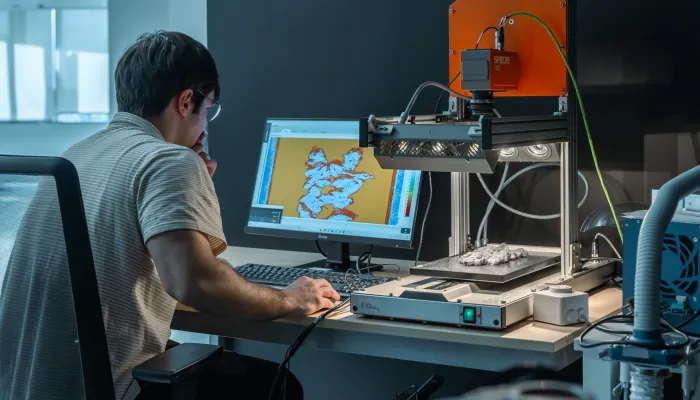
For recycling plants in particular, this is especially valuable, as it enables materials to be identified and classified automatically. Optical sensors and learning algorithms analyse in real time the materials passing along a conveyor belt, sorting them with greater precision than manual methods.
The benefits for the recycling industry are directly linked to productivity: an increase in the volume of materials recycled, a reduction in the costs associated with the process, and — above all — a reduced environmental impact through greater material recovery.
Artificial Intelligence is already a reality in the industrial sector, and its adoption will make the difference in companies' levels of competitiveness. The question now is identifying the right partner to accompany you through the process, as there are challenges that cannot be overlooked — technological integration, cybersecurity and privacy, and change management.
Having the right ally on this journey is essential. At CIRCE, we will support you with scalable solutions tailored to your needs. Exploring AI solutions today could be the key to a more efficient and competitive future for industry.
Is your company ready to take the next step? Get in touch with us!