

AI for characterising waste and optimising industrial energy
Artificial intelligence is beginning to enter the heart of industrial processes. In this context, the use of waste as an alternative fuel poses a key challenge: its behaviour is highly variable and difficult to predict. CIRCE is developing a technology to reduce that uncertainty and move towards more efficient and controlled industrial operations.
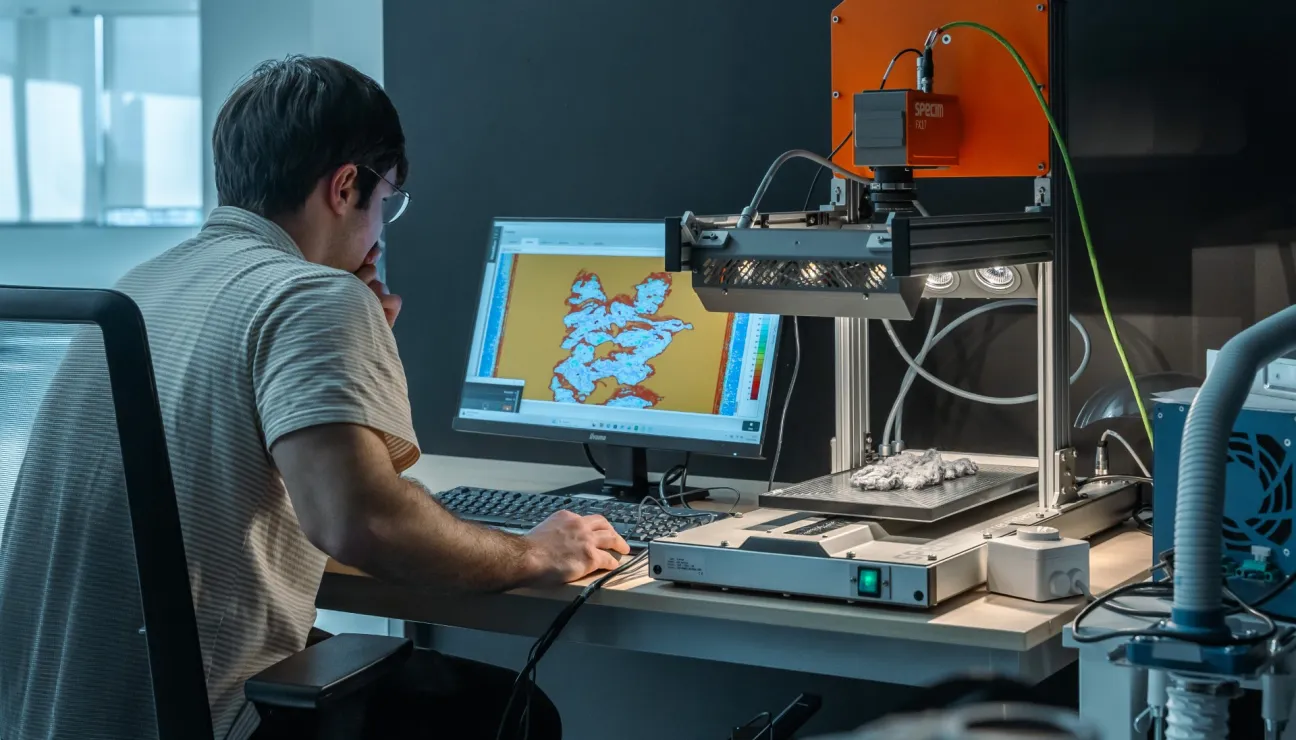
Before waste reaches the furnace, it is already possible to have a system that knows how it will behave during combustion. That is the objective of the technology CIRCE is developing from its laboratory in Zaragoza, within the framework of a proof of concept (PoC) driven by All4Zero: a computer vision system that analyses different types of waste — plastics, wood, paper, or organic matter — moving along a conveyor belt and predicts their key properties before the thermal process begins.
This approach represents a shift from the traditional model, which is based on reactive adjustments once combustion has started. CIRCE's technology enables earlier action by anticipating characteristics such as calorific value or moisture content of the waste with high precision. The system opens up the possibility of adapting parameters such as ventilation or furnace feed according to the material entering the process, rather than relying solely on historical average values.
From uncertainty to real-time control
In industrial sectors such as cement and steel, the use of waste as an alternative fuel is an established practice aligned with the principles of the circular economy — less dependence on fossil fuels and a lower carbon footprint. However, its variability introduces operational complexity: composition, moisture content, and energy contribution can vary significantly between batches, making process control more difficult and affecting efficiency.
The PoC developed by CIRCE addresses precisely this challenge through the use of artificial intelligence to characterise waste before it enters the furnace, providing advance information that can facilitate more stable and robust operations.
The solution: artificial intelligence applied to waste
The system being developed by the technology centre within the All4Zero initiative — a national alliance bringing together major industrial companies to accelerate decarbonisation through innovative technologies applied to real processes — combines a hyperspectral camera, installed above the conveyor belt, with artificial intelligence algorithms trained to extract very high-resolution information from the light emitted and reflected by the materials.
As the waste moves along, the system analyses it in real time and generates a precise estimate of its properties prior to energy recovery.
The first results obtained in the laboratory demonstrate the potential of this approach for predicting these key variables of the waste, with a level of precision that opens the door to future deployment in real industrial environments — one of the objectives of the PoC.
Validated with major industry
Under an open innovation and industrial environment validation model, CIRCE works in direct collaboration with Holcim, Urbaser, and ArcelorMittal — three of the most significant players in their respective sectors — which ensures that the technology responds to real operational needs and that its scalability is considered from day one. This combination of technical rigour and industrial focus is what distinguishes CIRCE's work: applied research that goes beyond the laboratory.
Aragón, at the heart of industrial innovation
What CIRCE is developing in Zaragoza demonstrates how a region can lead the industrial transition using its own capabilities, by combining internally generated knowledge, collaboration with major industry, and the application of technology.
In a context where decarbonisation is an unavoidable priority for European industry, CIRCE shows that the key lies not only in changing energy sources, but in relearning how to operate with them in order to use them more intelligently.