


Electrical protection now fits inside a box—how is virtualization redefining grid operations?
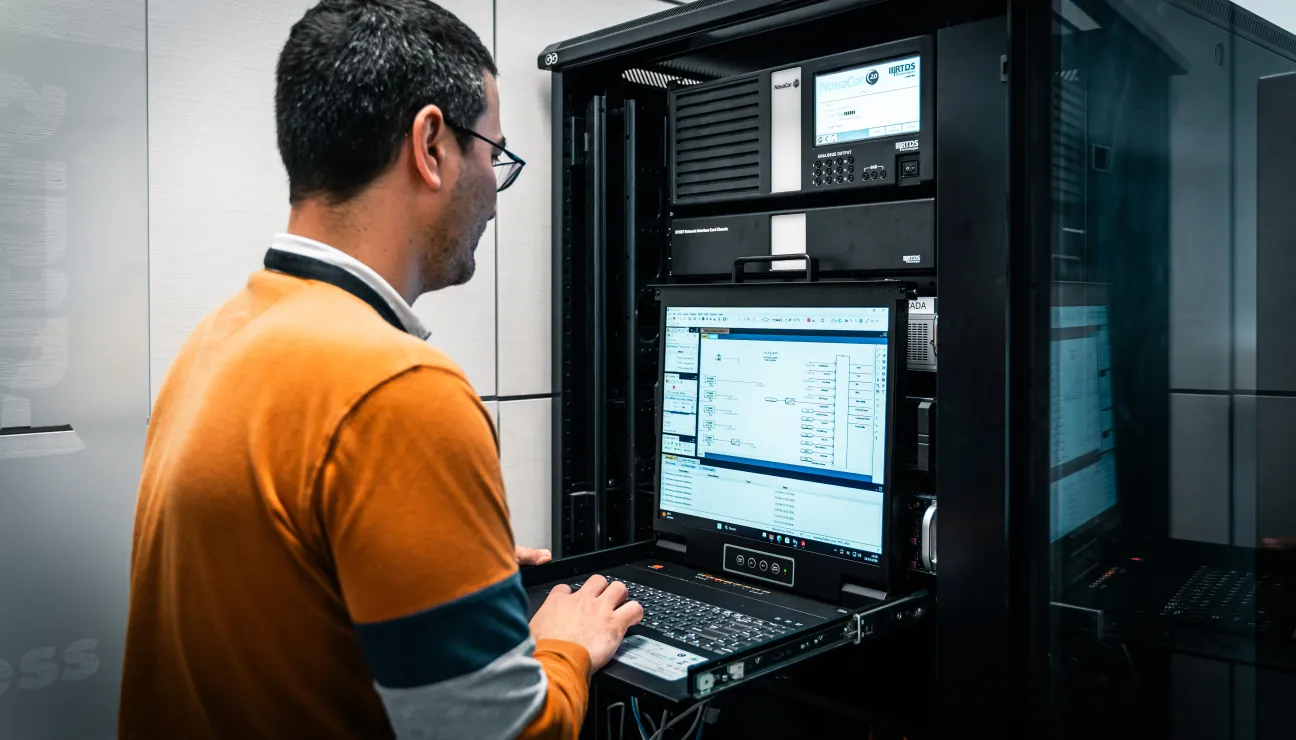
Electrical Protection Architectures Were Designed for a Predictable Grid. Today, the Grid Has Changed. For decades, power systems operated under a clear principle: stability. Protection and control architectures were designed to perform in a relatively predictable environment, where grid behaviour was well understood and changes occurred gradually. That context no longer exists.
The growing penetration of renewable energy sources introduces continuous variability into power flows. The widespread adoption of power electronics is changing system dynamics and response characteristics. At the same time, increasing interconnection is turning substations into data-driven nodes within a far more complex and interconnected network.
Grid operation is no longer defined by stability—it is defined by dynamism. And that changes the rules.
When Architecture Becomes an Operational Constraint
In this environment, the issue is not the hardware itself. Conventional protection equipment remains highly reliable and deterministic. The limitation arises when system intelligence is encapsulated within that hardware.
As a result, every evolution becomes tied to lengthy equipment replacement cycles. Introducing new functionalities becomes increasingly complex, while dependence on specific vendors restricts technological flexibility and decision-making.
As the grid continues to evolve, this rigidity creates a widening gap: the system changes faster than the architecture designed to protect it.
In certain scenarios, this limitation is no longer merely technical—it becomes operational, directly affecting the power system's ability to respond to new challenges.
A Paradigm Shift: Separating the Function from the Device
This is where protection and control virtualization introduces a fundamental shift. The concept is straightforward: decouple protection and control logic from physical hardware and transform it into software capable of running across multiple computing environments—from edge platforms to distributed and hybrid architectures.
This model, commonly known as vPAC (Virtual Protection, Automation and Control), moves the focus away from the device and toward the function itself.
Intelligence is no longer tied to a specific box. It becomes deployable, scalable, and continuously updatable. This is not an incremental improvement—it is a transformation in the way grid architectures are designed.
The Real Challenge: Preserving Reliability Beyond Hardware
Applying this concept to critical electrical infrastructure introduces a fundamental challenge. Protection functions cannot fail. They cannot behave unpredictably. They cannot depend on execution variability. They must operate within milliseconds, respond correctly to real-world events, and maintain fully deterministic performance. For this reason, the true challenge is not technological—it is operational.
The key question is how to preserve the historical reliability guarantees of hardware-based systems within a software-defined environment. In this context, real-time validation is no longer a complementary step. It becomes an essential requirement.
Validate Before You Deploy
Virtualization is only viable if its behaviour can be verified before deployment. This requires reproducing real grid conditions—including faults, transients, oscillations, and disturbances—in controlled environments where protection and control functions can be evaluated under demanding operating scenarios.
Real-time electromagnetic simulation and Hardware-in-the-Loop (HIL) testing make it possible to verify response times, coordination between protection functions, and system robustness under extreme conditions.
This approach reduces uncertainty and enables organizations to move toward more flexible architectures without compromising reliability.
Beyond Technology: Operational Benefits Across the Value Chain
The impact of virtualization extends beyond technology alone. For manufacturers, it creates opportunities to develop and deploy new functionalities more efficiently, shortening development cycles and accelerating adaptation to emerging requirements. For utilities, TSOs, DSOs, and system integrators, it provides a path to modernize protection architectures progressively, introduce new capabilities without complete hardware replacement, and reduce the risks associated with infrastructure transformation.
In both cases, the result is greater adaptability in a power system that can no longer rely on rigid, long-term operating models.
Why Is This Happening Now?
Virtualization is not a temporary trend. It is the natural consequence of two technological developments that are already firmly established:
- The digitalization of electrical measurement and communications.
- The widespread availability of computing power at the edge of the grid.
The power system is already operating under these conditions. Protection architectures must evolve accordingly. At CIRCE, we work alongside manufacturers, utilities, and system integrators to enable this transition in a controlled and reliable manner.
Our approach combines the development of protection and control functions adapted to software environments with rigorous validation under realistic grid conditions, ensuring that modernization never comes at the expense of operational security.
The objective is not simply to introduce new technology. It is to ensure that technology can be integrated safely into critical infrastructure.
Evaluate Before You Transform
Virtualization does not require a complete transformation from day one. In many cases, the first step is simply to assess the existing architecture, identify which functions are suitable for virtualization, and determine the conditions under which that evolution can take place.
This approach enables organizations to define a technical roadmap without disrupting operations, while gaining a realistic understanding of both opportunities and risks.
Grid Architectures Are Changing, the Real Question Is How to Approach the Transition
Virtualization is no longer a future concept—it is becoming a necessary capability for operating modern power systems. The differentiator will not be who adopts this approach, but who adopts it with the appropriate level of technical rigor.
Is your organization evaluating how to approach this transition?
At CIRCE, we can help you assess your current architecture and define a practical pathway toward virtualized protection and control systems—without compromising grid reliability or operational stability.