

Scope 3: Why It Is the Biggest Decarbonization Challenge for Companies and Their Suppliers

The rise of ESG reporting, regulatory pressure, and the demands of customers and investors are forcing organizations to go beyond the direct perimeter of their operations.
In previous articles, we addressed carbon footprint calculation from a methodological and regulatory perspective, explaining how Scopes 1 and 2 are structured and the implications of the new regulatory framework in Spain. However, as organizations move forward in this process, they discover that most of their emissions are not generated in their facilities or through their direct energy consumption.
This is when the focus shifts to Scope 3, the most complex component and, at the same time, the most decisive in terms of climate impact. Scope 3 represents the greatest challenge for industry because it largely depends on decisions made by suppliers, logistics operators, and other actors in the value chain.
In this context, Scope 3 has taken center stage because it accounts for the majority of emissions and highlights the real limitations of traditional decarbonization approaches. For many companies, this is the point at which climate strategy stops depending solely on internal decisions and becomes conditioned by the entire value chain.
What Scope 3 Really Means for a Company
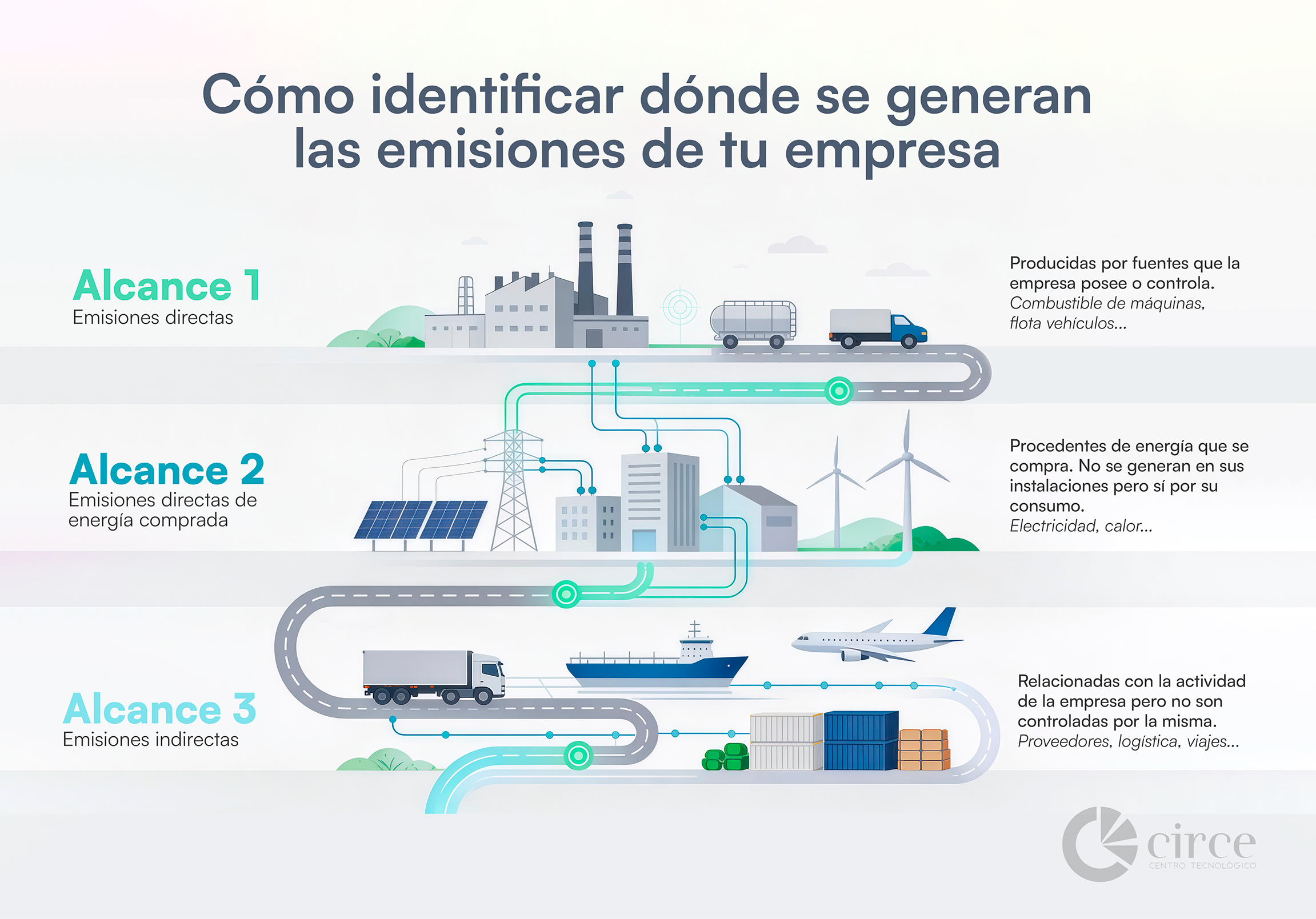
Scope 3 includes all indirect emissions generated along the value chain that are not directly controlled by the company but are linked to its activity.
Unlike Scopes 1 and 2, Scope 3 depends on decisions made by third parties: suppliers, logistics operators, customers, or even employees. This dependence is the main source of complexity. It not only makes it difficult to obtain reliable data, but also introduces a loss of control that forces companies to rethink how reduction strategies are designed.
In industrial, logistics, or energy-intensive service sectors, Scope 3 usually represents the largest share of the total carbon footprint. However, in many cases it is calculated based on generic estimates, which limits its usefulness in driving real change.
Scope 3 Concentrates the Majority of Emissions
The weight of Scope 3 is no coincidence. The outsourcing of production processes, the globalization of supply chains, and the reliance on logistics services mean that a large portion of a company’s climate impact is generated outside its facilities.
Raw materials, component manufacturing, transportation, distribution, product use, and end-of-life management are energy- and emissions-intensive activities that fall outside direct control but are directly linked to the business model.
Why Suppliers Are Key to Reducing Scope 3
It is not possible to reduce Scope 3 without actively involving suppliers. They account for a significant share of emissions associated with production processes, energy consumption, and logistics.
The main obstacle is information asymmetry. While leading companies require increasingly detailed and traceable data, many suppliers — especially SMEs — lack the technical capabilities, resources, and appropriate tools to generate that information with the required level of rigor.
As a result, Scope 3 is transforming the customer–supplier relationship: it is no longer just a reporting exercise, but a factor of competitiveness, market access, and continued participation in the supply chain.
Without primary and traceable data, it is difficult to identify which operational, energy, or logistics decisions generate the greatest impact. The risk is that Scope 3 becomes a declarative exercise, disconnected from the operational reality of both the company and its suppliers.
To move toward real reductions, it is necessary to progressively improve data quality and link carbon footprint calculation to decision-making. At this point, having a structured approach to calculating and documenting the footprint helps move from estimated data to traceable and comparable information; at CIRCE, we explain this in detail in the methodological approach behind NetBalance.
What Real Difficulties Suppliers Face Today Regarding Scope 3
The lack of internal technical capabilities, difficulty accessing reliable data, and uncertainty about the return on necessary investments are common barriers.
This is compounded by an increasingly demanding regulatory environment, which raises the expected level of methodological rigor and traceability in carbon footprint calculations. In Spain, this context is being reinforced by the new Royal Decree on carbon footprint, which increases the importance of robust and verifiable accounting within organizations.
Why Scope 3 Requires Collaborative Management
Scope 3 cannot be addressed in isolation or on a company-by-company basis. The key is not only to demand information, but to build capabilities throughout the value chain, provide common tools, and align methodologies. In practice, many organizations are using frameworks and platforms that help structure the process (data collection, evidence gathering, methodological consistency, and scaling across sites/suppliers); one example of this type of approach is described on the NetBalance landing page.
What Scope 3 Means as a Strategic Factor for Companies
Scope 3 is becoming a top-tier competitive factor. It is not merely a measurement issue, but a structural challenge that requires companies to rethink how supply chains are designed, managed, and optimized.
Suppliers become key actors in the transition, and decarbonization turns into a technical and progressive process, not just a declarative one. In this new scenario, Scope 3 is no longer optional: it is the foundation on which corporate climate credibility is built.
If you need support with calculating your organization’s carbon footprint, do not hesitate to contact our experts.