

CIRCE highlights energy risk management as a key driver of industrial competitiveness
Energy market volatility is no longer a temporary concern but has become a strategic factor shaping industrial competitiveness. Against this backdrop, CIRCE brought together representatives from some of Spain’s leading industrial and energy companies at the event The New Energy Landscape, held in Madrid. The aim of the gathering was to identify practical solutions to reduce dependence on fossil fuels and minimise the impact of uncertainty on investment decisions.
Throughout the event, representatives from Stellantis, Holcim, Fertiberia, Naturgy, Urbaser and GreenYellow shared real-world experiences and case studies involving electrification, energy efficiency, self-consumption and resource recovery. The consensus was clear: industry can no longer afford to simply react to energy crises. While market disruptions can unfold within days, the investments required to protect businesses from them often take months, or even years, to plan and implement.
From energy prices to energy risk
The opening session was delivered by Víctor Ballestín, Director of Energy Efficiency at CIRCE, who explained that the main challenge facing industry is no longer energy prices alone, but the inability to predict how markets will evolve over the coming months.
During his presentation, Ballestín highlighted that decisions such as electrifying industrial processes, deploying self-consumption systems or implementing new flexibility solutions typically require between twelve and eighteen months to materialise, whereas energy crises can cause prices to surge within days.
In this context, he argued that the most effective strategy is to act on industrial processes rather than relying solely on supply contracts. Energy efficiency, electrification, heat recovery and self-generation can structurally reduce exposure to market volatility, while financial instruments merely soften its short-term effects.
He also reviewed some of the funding opportunities currently available to support this transformation, ranging from Spain’s Energy Savings Certificates (CAEs) to European programmes such as the Innovation Fund and new initiatives focused on industrial heat electrification.
Energy moves to the centre of industrial strategy
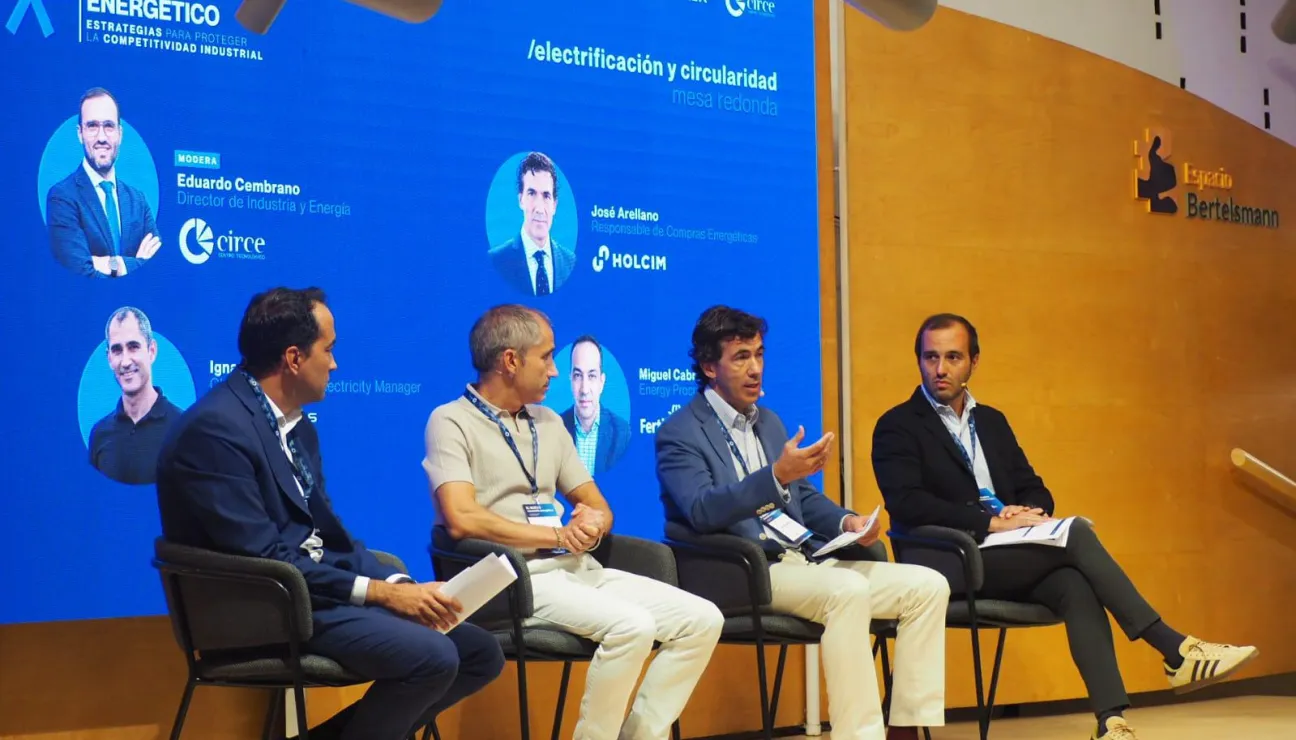
The first panel discussion featured Ignacio Cortés (Stellantis), José Arellano (Holcim) and Miguel Cabrero (Fertiberia), who highlighted how energy management has become a strategic function within industrial companies.
The speakers agreed that energy efficiency, self-consumption, energy storage and electrification are essential tools for increasing plant resilience and reducing exposure to market volatility.
José Arellano explained how energy management has become an integral part of Holcim’s operational planning, enabling production to be adapted to energy price signals and opportunities arising from flexibility markets. He also highlighted transport route optimisation as a key lever for improving efficiency and reducing costs in an environment marked by energy uncertainty.
Meanwhile, Ignacio Cortés shared Stellantis’ experience in deploying self-consumption, storage and electrification projects across several European production sites. Miguel Cabrero emphasised that energy efficiency remains one of the most effective tools for strengthening industrial competitiveness.
The three speakers also highlighted the growing role of industry in flexibility markets and grid support services, helping to improve electricity system stability while creating new value streams.
There is no single solution for the energy transition
The second panel focused on the role that biomethane, industrial electrification, energy storage and waste valorisation can play in supporting a more competitive and sustainable industrial sector.
Lídia Caramazana of Naturgy stressed the need to advance simultaneously in security of supply, competitiveness and sustainability, while highlighting biomethane’s potential to decarbonise industrial processes by leveraging existing infrastructure.
Nicolás Daunis of GreenYellow underlined that many of the technologies needed to reduce exposure to energy risk are already available and operating successfully in industry, from industrial heat pumps to thermal storage and heat recovery systems.
Eduardo Quero of Urbaser presented the circular economy perspective, explaining how waste treatment facilities can recover resources and generate energy, contributing to both decarbonisation and energy security.
The speakers agreed that no single technology can address every industrial challenge and advocated for tailored solutions adapted to the specific needs of each production process.
CIRCE supports industry in decision-making
The event also showcased how CIRCE is helping companies turn energy uncertainty into informed investment decisions.
During the closing session, Luis Pérez Heras, CIRCE’s Industry Director, presented the centre’s capabilities to support industry across all stages of the energy transition, from identifying energy-saving and electrification opportunities to technology validation, techno-economic assessment and access to funding.
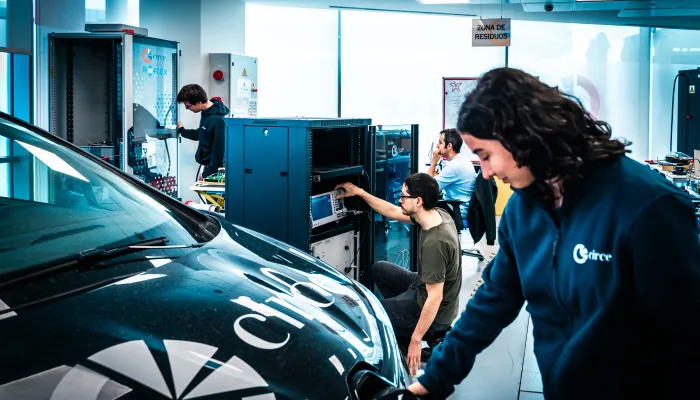
To achieve this, CIRCE offers proprietary modelling and simulation tools capable of assessing investment scenarios, analysing CAPEX and OPEX impacts, and estimating the economic return of different technological alternatives. These capabilities are complemented by its industrial laboratory in Alfajarín, where technologies related to electrification, energy storage, waste valorisation and renewable fuels are tested and validated.
The centre also works with industrial companies, technology developers and investors to validate innovative solutions and reduce the risks associated with first-of-a-kind industrial deployments.
Turning uncertainty into opportunity
A key message emerged from the event: in an increasingly uncertain energy environment, industrial competitiveness will depend on companies’ ability to anticipate change, reduce risks and accelerate the deployment of technologies that provide long-term stability.
In this process, CIRCE reaffirmed its role as a technology partner for industry, helping companies evaluate alternatives, validate technologies and turn energy challenges into viable, bankable and technically robust projects.
Other related news