

From Excel to AI: how to accelerate techno-economic decarbonisation studies with AI
Evaluating technological alternatives, estimating their economic impact, and understanding how they affect operations requires time, data, and multiple iterations. The problem is not so much the lack of solutions, but the difficulty of analysing them with sufficient speed and depth. This preliminary analysis is also a critical step: decarbonisation projects involve very high investments for companies, making a solid evaluation essential before making any decisions. In an environment marked by energy price volatility, regulatory pressure, and the need to justify investments, the speed of analysis is becoming as important as the result itself.
The current limitation: slow studies for urgent decisions
Techno-economic decarbonisation studies still rely on traditional methodologies. Engineers build models, typically in spreadsheets, where they integrate energy consumption, costs, operational assumptions, and possible technological configurations.
This approach allows detailed control of the analysis but comes with a high time cost. Each modification requires rebuilding part of the model, reviewing assumptions, and validating results. When comparing multiple alternatives—for example, electrification versus hydrogen or hybrid solutions—the process multiplies.
In practice, this translates into studies that can take around a week of work. In addition, as these are manual processes, there is a risk of error and a limited ability to iterate scenarios. Often, not all possible options are analysed simply because there is not enough time.
DescarbonIA: from problem description to pre-study
In this context, DescarbonIA introduces a significant change in how these studies are approached. It is the tool that underpins our techno-economic consulting service—not software that the client purchases or uses independently.
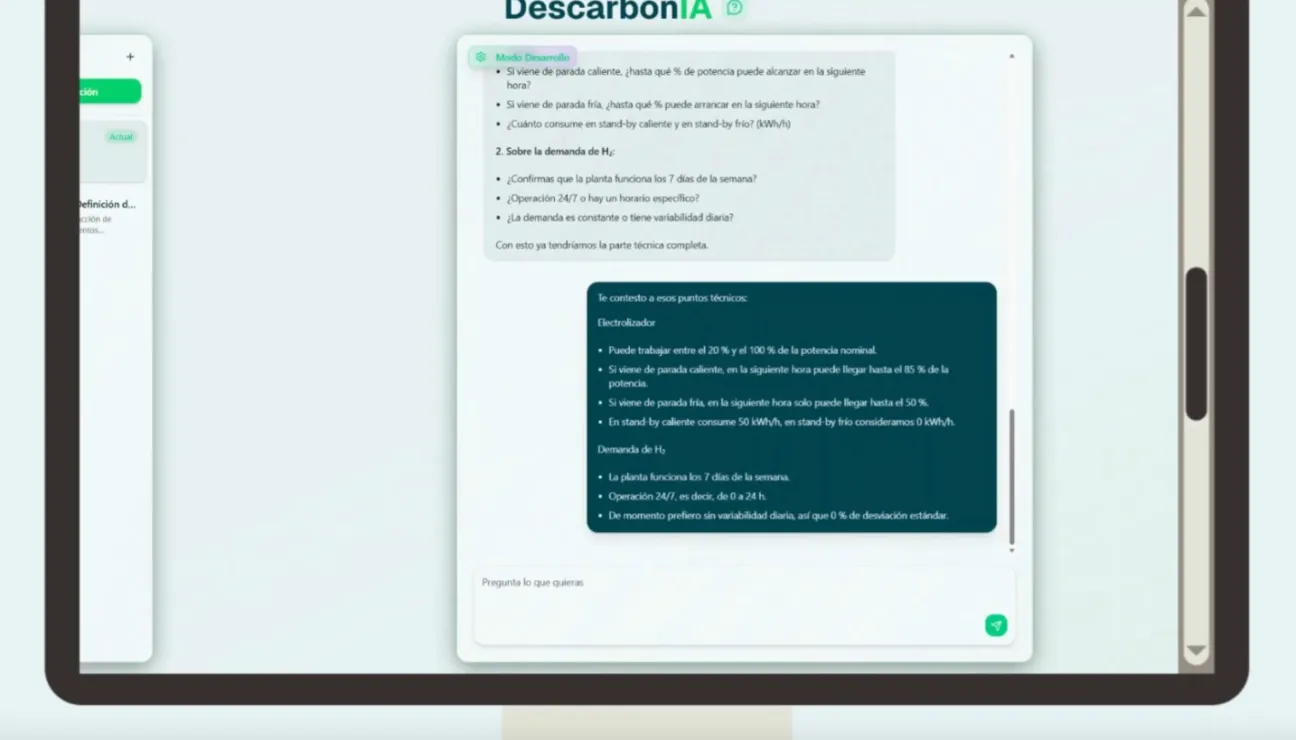
It is a conversational AI-based platform that transforms a technical description of a problem into a structured pre-study. The engineer does not start from an Excel model, but from a conversation in which they define the case: what the industrial process looks like, which fuel is used, what needs to be replaced, and which alternatives should be evaluated.
Based on this information, the tool automatically structures the case, builds the model, and generates comparable results. Internally, it combines natural language processing with mathematical and optimisation models, enabling it to accurately represent system behaviour, including aspects such as hourly variability and operational constraints.
The result is a set of technical and economic scenarios that include key indicators such as energy consumption, emissions, CAPEX, OPEX, and cost metrics like LCOx, along with useful information for interpreting operations.
Faster, but above all more iterative
One of the most visible impacts is the reduction in time. Studies that traditionally required several days—or even weeks—can now be developed in one or two days.
However, the most relevant change is not just speed. It is the ability to iterate.
By reducing the effort required to build each scenario, engineers can explore many more alternatives. This includes different degrees of fuel substitution, combinations of technologies, integration of renewables, or different operational strategies.
This approach allows working with a broader analytical base before making decisions, improving the quality of the process—not just its speed.
Additionally, by structuring the model from the outset, the risk of errors associated with manual processes is reduced, and the traceability of results is improved.
Use case: hydrogen in industrial processes
Currently, one of the main application areas of DescarbonIA is the analysis of hydrogen as a decarbonisation vector, although the tool is designed to address a wide range of industrial use cases.
In industries where natural gas remains predominant—such as thermal processes in ceramics or steel—its substitution with hydrogen raises multiple uncertainties. Not only in terms of cost, but also in process integration and operational feasibility.
Through DescarbonIA, our technical team introduces variables such as fuel demand, current fuel type (usually natural gas), potential hydrogen demand, availability of renewable generation, and even operational information such as the presence of batteries or current energy costs.
From these inputs, different scenarios are generated to quickly compare alternatives: from direct substitution to hybrid configurations combining hydrogen, electricity, and renewables. This makes it easier to identify which options are technically and economically viable in each case.
Integration into a technical support process
It is important to understand that DescarbonIA is not intended as a standalone tool for clients.
It is part of a technical support service in which the generated results are used as a basis for working with the company: validating solutions, defining technological configurations, analysing plant integration, and studying operations.
This makes it possible to go beyond the pre-study and move towards decisions with real impact on plant operations, especially in complex projects such as hydrogen implementation or the transformation of thermal processes.
Decide earlier, decide better
Accelerating studies does not mean simplifying them, but eliminating inefficiencies in their development. At CIRCE, we support this process with DescarbonIA by reducing timelines, improving analytical consistency, and facilitating the exploration of alternatives alongside the company’s technical team.
If your company is evaluating decarbonisation alternatives and needs to move forward more quickly and rigorously in the analysis phase, at CIRCE we can help you structure the study, compare scenarios, and support decision-making with solid technical criteria. Get in touch with our technical team.