

LCA and Carbon Footprint: How to turn environmental data into business decisions
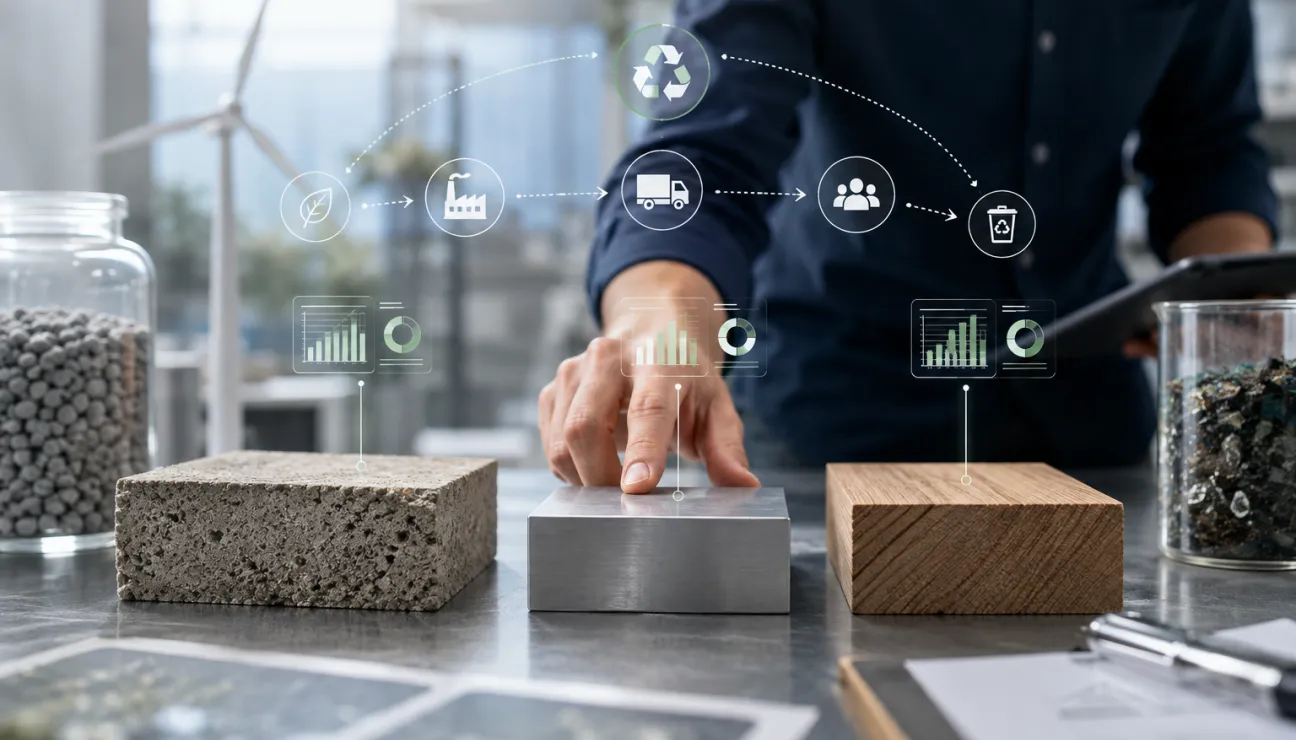
Sustainability is generating an ever-growing volume of data within companies. Greenhouse gas emissions, energy consumption, raw materials, transport, waste, water use and information from suppliers are now among the indicators that many organisations need to collect, validate and use.
Regulatory pressure, ESG requirements and requests from customers and supply chains have accelerated this process, turning environmental data into a prerequisite for competing in many markets. However, having more environmental information does not necessarily lead to better decisions.
A company may know a product's carbon footprint and still not know which alternative it should prioritise to reduce it. It may reduce the weight of packaging while simultaneously increasing product losses or making the packaging less recyclable.
The challenge is therefore changing: it is no longer simply a matter of measuring environmental impact. It is about turning that information into a technical and strategic decision-making criterion.
Carbon Footprint and LCA: Two Related but Distinct Tools
Although the terms are often used interchangeably, carbon footprinting and Life Cycle Assessment (LCA) do not answer exactly the same question.
A product carbon footprint quantifies the greenhouse gas emissions associated with a product, identifies where emissions are concentrated and establishes a baseline for reducing them. The results are expressed in CO2 equivalent. LCA makes it possible to examine all associated impacts, from raw material extraction and manufacturing through distribution and use to end-of-life treatment, where applicable. Its framework and requirements are set out, among other references, in ISO 14040 and ISO 14044.
In Europe, the European Commission's Environmental Footprint methodology provides a common framework for measuring and communicating environmental performance throughout the life cycle.
It is therefore not a matter of choosing one tool over the other. The key is to use the appropriate level of analysis for the decision at hand.
The Mistake: Measuring After the Decision Has Already Been Made
One of the most common limitations arises when environmental analysis is carried out at the end of the process as a retrospective check.
The product is designed, materials are selected, suppliers are chosen and the manufacturing process is defined. Only then is its environmental impact calculated.
This approach provides a result and may be necessary to meet certain customer, ESG reporting or communication requirements. However, it fails to capture much of the potential of these methodologies.
By the time the analysis is performed, many of the decisions that determine the impact have already been locked in.
LCA delivers its greatest value before a decision is made, not afterwards.
Integrating environmental analysis at an early stage makes it possible to ask different questions: what happens if we change a raw material? What if we reduce the product's weight? What if we modify the process, use recycled material, change supplier or extend the product's service life?
Instead of merely describing the impact of an existing solution, the analysis compares possible scenarios. That difference turns an environmental tool into a business tool that supports decision-making.
From Measuring Impacts to Comparing Scenarios
The value of this approach becomes clearer when applied to common decisions in sectors such as industry, food and construction. In all of them, small choices involving design, sourcing or processes can have significant consequences for total impact.
Materials and Raw Materials
Material selection determines a significant share of the environmental impact of many products. Comparing alternatives solely on price, technical performance or recycled content may overlook relevant variables related to production, origin, processing, transport or end of life.
LCA makes it possible to analyse these factors within a single framework and assess what happens when a particular decision changes. This is especially useful when several alternatives are technically feasible and environmental performance needs to be included as an additional selection criterion. For example, a recycled material may reduce certain impacts but increase others if it requires more transport, treatment or processing energy.
Ecodesign (Product and Packaging Design)
Using less material, making packaging lighter or replacing a component may automatically appear to be an environmental improvement. However, the outcome depends on the system as a whole.
A change may affect transport, product preservation, durability, recyclability or performance during use.
This is why life cycle assessment is particularly valuable when integrated into ecodesign processes: it allows alternatives to be compared before the design is finalised and reveals which variables truly offer the greatest potential to reduce impact.
Industrial Processes
The same approach can be applied to decisions about production processes, such as process electrification, fuel switching, heat recovery or waste recovery. Changes to raw materials, efficiency improvements, energy-system modifications, by-product recovery and circularity strategies can be assessed through different scenarios to determine how they affect overall environmental performance.
This brings the environmental dimension into decisions that have traditionally been evaluated solely on technical or economic criteria.
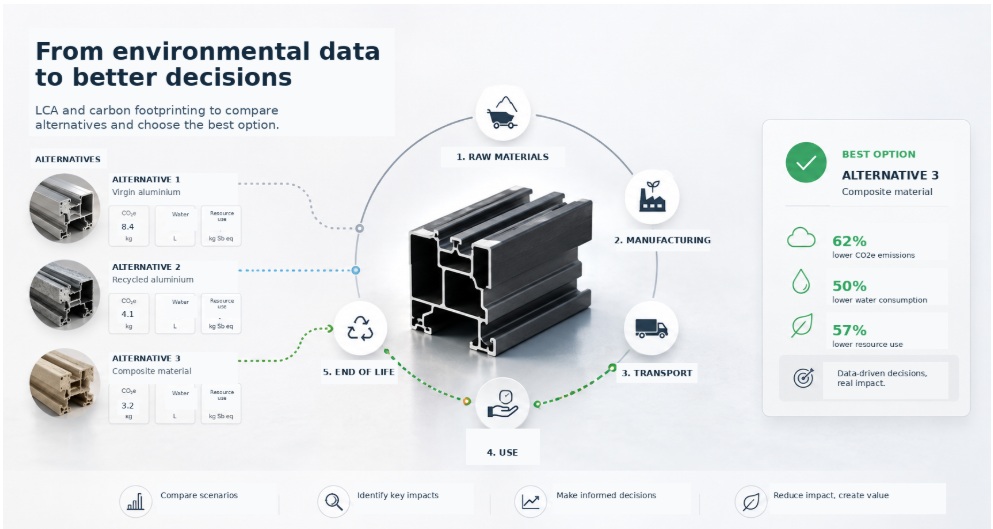
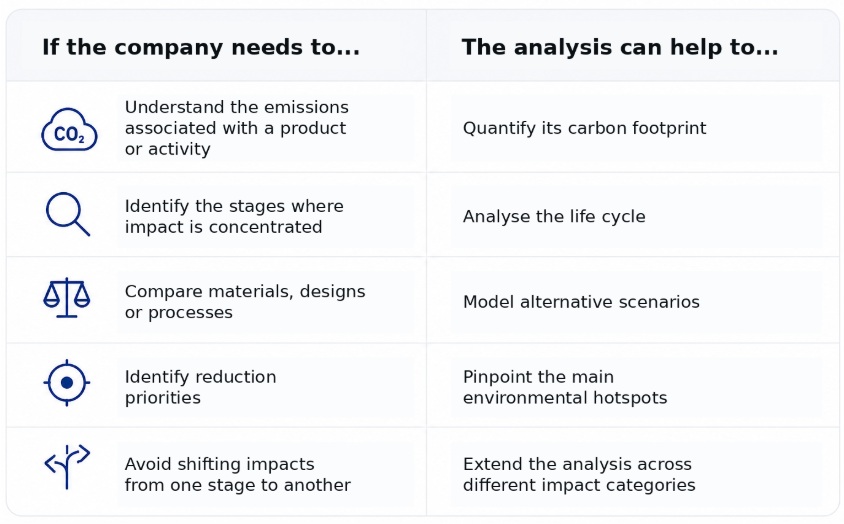
When Reducing CO2 Does Not Necessarily Reduce Environmental Impact
Focusing on a single indicator introduces another risk: improving one part of the problem while making another worse.
An alternative may reduce emissions at a particular stage while increasing other impacts or environmental categories because of resource consumption, transport, the manufacturing process or end-of-life treatment.
An improvement at one stage may also simply shift the impact to another. This is known as environmental burden shifting.
This does not mean that every decision necessarily requires a complete analysis across multiple impact categories. It means that the scope of the study should reflect the complexity of the decision.
The option with the lowest carbon footprint is not necessarily the one with the lowest overall environmental impact.
Understanding that difference before investing, redesigning a product or modifying a process can be crucial to avoiding decisions that appear sustainable but are environmentally counterproductive.
LCA in the Early Stages of Product Development
This ability to anticipate outcomes makes LCA particularly valuable in innovation and new product development.
Traditionally, much environmental information has been used to assess existing products. However, when analysis is incorporated into the design process, it can be used to explore alternatives before certain decisions become difficult or costly to change.
Materials, weight, energy consumption, service life, repairability, logistics, recycled content and end-of-life scenarios can all become design variables.
The aim is not to find an environmentally perfect solution, but to obtain enough information to understand which decisions have the greatest influence and what trade-offs exist among the alternatives.
A CIRCE example illustrates this logic: in an LCA study of supported housing, the analysis identified the elements that contributed most to the impact and showed how a decision about materials could also change environmental performance during the use phase. See the Las Fuentes supported housing case study.
From Environmental Data to Competitiveness
The business value of these tools does not end with reducing impacts.
A growing number of companies need to substantiate the environmental performance of their products for customers, tenders, supply chains, investors or sustainable procurement processes. At the same time, decisions involving materials, energy, suppliers and circularity are increasingly linked to costs, resource availability and value-chain resilience.
Structured, traceable environmental information makes it easier to meet these demands, but its true potential emerges when it is used internally to guide decisions.
A company that identifies which components account for most of its impact can prioritise its efforts more effectively. An organisation that compares scenarios before redesigning a product reduces uncertainty. And a company that knows where its main hotspots lie can focus its resources where the real potential for improvement is greatest.
The important step, therefore, is not simply to have more ESG indicators. It is to connect those indicators to decisions about products, processes, procurement and investment.
CIRCE's Role: Turning Environmental Analysis into a Decision-Making Criterion
At CIRCE, our work ranges from environmental diagnosis and scenario comparison to defining recommendations based on carbon footprint calculations and Life Cycle Assessment, always with a practical focus on decision-making.
The aim is not merely to obtain an environmental indicator, but to understand what lies behind the result and how it can be used to compare alternatives.
To achieve this, we combine rigorous definition of the study scope, data analysis and structuring, scenario modelling, interpretation of results and identification of the life-cycle stages that contribute most to the impact.
This approach enables us to work with companies in industry, agri-food, construction and other sectors that need to incorporate environmental criteria into decisions about products, materials, processes or supply chains.
Measurement remains essential. But measurement alone does not transform a product or reduce its impact.
Measurement tells us where we are. Comparing scenarios helps us decide where to go.
If your organisation needs to calculate a product's carbon footprint, conduct a Life Cycle Assessment or compare alternatives to guide a design, procurement or process decision, contact the CIRCE team to discuss which approach best suits your needs.
Latest news