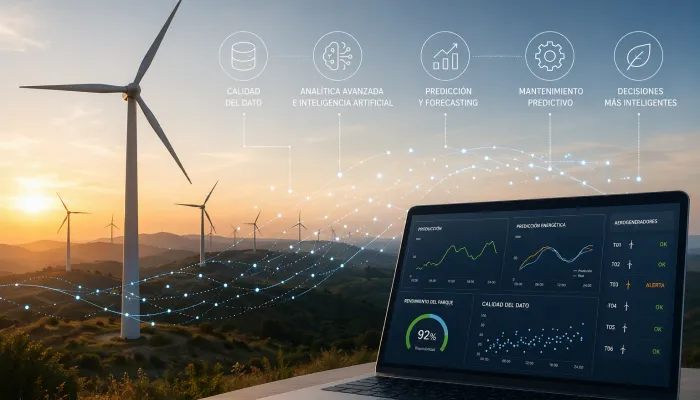


The truth behind P50: how to identify hidden risks in a wind farm before acquisition

In a context where the wind and solar asset transaction market continues to grow, the pressure to close deals within tight timelines sometimes leads to relying solely on historical production reports. However, there is a fundamental difference between what a wind farm has produced in the past and what it is expected to generate in the future under normal resource, operational and market conditions.
When acquiring a generation asset, what is actually being purchased is not its past performance, but its ability to generate energy under expected conditions over time.
A common case: when P50 does not tell the full story
A few months ago, an investment fund was analyzing the acquisition of an asset with an excellent track record, proper availability and an apparently solid P50. The transaction was progressing quickly until a key question arose: how much of this P50 depends on assumptions that have not been reviewed since commissioning?
The energy due diligence revealed what executive reports did not show:
- The analyzed period was not representative of long-term expectations
- Certain losses were categorized too optimistically
- Uncertainty was underestimated
The asset remained attractive, but its actual value was significantly lower.
P50 is not a figure, it is a bankable hypothesis
One of the most common mistakes in some energy due diligence processes is relying entirely on theoretical models or seller-provided reporting without validating them against the asset’s real operational performance.
A truly bankable energy yield requires a traceable quantification based on real operational data, but also forward-looking projections that reflect the actual behavior of the asset throughout its lifetime.
For a P50 value to withstand scrutiny from an investment committee or a financial institution, several key technical aspects must be verified:
Rigorous climate normalization:
A production history can be misleading if it is not correlated with consistent long-term resource references. Databases and climate models such as ERA5 or Vortex allow assessing whether the analyzed period is representative or biased by unusually favorable or unfavorable wind conditions.
Detailed SCADA data analysis:
Aggregated monthly reports rarely reflect the real behavior of the asset. A robust technical analysis requires working with:
- High-resolution SCADA data (10-minute intervals)
- Alarm logs
- Energy meters
- Downtime events
This level of detail makes it possible to identify operational inefficiencies that are often hidden in standard reporting, where methodologies may be designed for other purposes and data traceability is not always clear.
Uncertainty assessment:
A standalone P50 does not provide sufficient information to assess the risk of the asset. It is necessary to document the different sources of uncertainty affecting the energy yield in order to derive consistent percentiles such as P75 or P90, which are essential in financing or refinancing processes, as they capture the risk associated with the energy estimation.
Loss traceability: where do the main risks lie?
An advanced energy review does not only validate production. It also analyzes in detail the origin of each energy loss.
This involves clearly separating, at least:
- Maintenance-related downtime
- Grid-related downtime
- Performance losses (underperformance)
- Electrical losses
- Unexplained operational losses
Unjustified or poorly categorized losses may indicate technical issues, suboptimal configurations or grid constraints that are not reflected in executive reports.
Moreover, it is not enough to quantify observed losses. It is also necessary to assess whether the losses recorded during the analyzed period are representative of expected behavior. Otherwise, isolated or non-recurring events may distort the P50 estimation and, consequently, the real valuation of the asset.
If it is not possible to accurately trace why each MWh is lost, it becomes difficult to properly assess the asset’s true potential.
From energy analysis to financial impact
In the current electricity market environment, energy due diligence must go beyond validating production. It must also assess how the asset’s behavior impacts its future revenues.
Among the most relevant aspects:
- Cash flow sensitivity: evaluating how project economics change under variations in expected production, availability or grid constraints.
- PPA vs Merchant scenarios: the value of an asset can vary significantly depending on its exposure to the electricity market or the existence of power purchase agreements (PPAs).
- Price capture: factors such as actual curtailment, technical downtime or the production profile directly influence the price captured by the asset and, therefore, its profitability.
Making decisions with technical confidence
Closing a transaction is a tactical decision. Structuring a solid investment is a strategic one.
A rigorous energy assessment based on real operational data makes it possible to identify technical risks before closing and provides a more realistic view of the asset’s future performance.
In this context, the combined analysis of energy engineering and economic evaluation has become a key element for investors, utilities and funds involved in renewable asset acquisition processes.
At CIRCE, we work on this type of advanced technical analysis, leveraging more than three decades of experience in energy assessment, modelling and data analysis applied to the renewable sector.