


How to Accelerate Your PPC Certification and Reduce Regulatory Risks: Validate Before You Certify
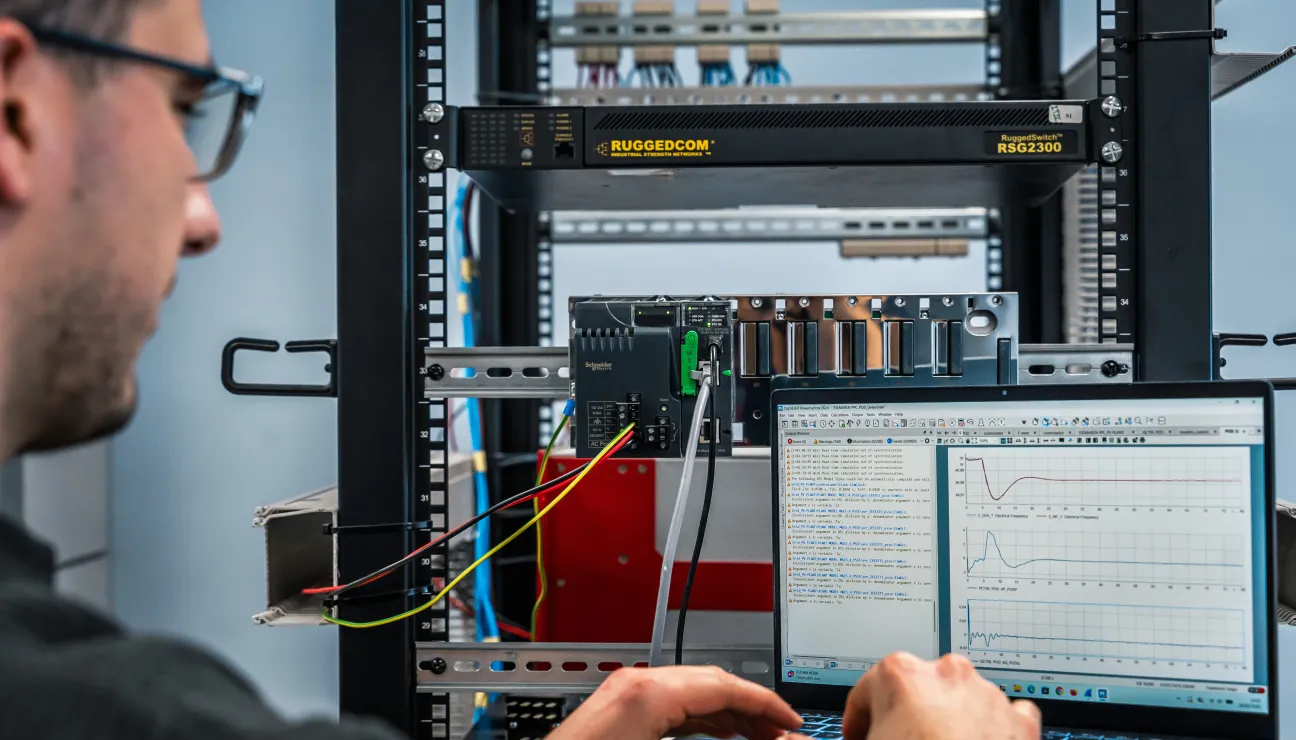
In the certification of a Power Plant Controller (PPC), it is not enough for the system to simply work. It must be demonstrated, through testing and documented evidence, that it fully complies with the applicable Grid Codes, the NTS, and the relevant regulatory framework.
And here lies the issue: the greatest risk for a PPC manufacturer is usually not technical — it is regulatory.
The Real Risk: Non-Conformities, Retesting, and Additional Costs
An incorrect interpretation of regulations, a misaligned NTS model, or tests that do not accurately reproduce the system operator’s required conditions can result in:
- Non-conformities during certification
- Mandatory retesting
- Weeks of delay in grid connection
- Additional costs of €30,000–€40,000 per project
For this reason, more and more manufacturers are adopting a simple strategy: validate before certifying.
What Does the Regulatory Framework Require from a PPC — and Why Can It Block Projects?
The technical evaluation of a PPC integrates requirements defined by the applicable grid codes in each country, which may include European regulations, national legislation, and specific technical specifications from the system operator. In Spain, this framework includes:
- Regulation (EU) 2016/631 (RfG) – Requirements for disturbance behavior, active/reactive power control, and stability.
- Order TED/749/2020 – Technical grid connection requirements necessary for implementing connection network codes.
In Spain, the conformity supervision framework is developed through the NTS; in other countries, this process is structured through the specific procedures and technical specifications of the corresponding system operator.
Technical Supervision Standard (NTS) – The Spanish conformity supervision framework that defines verification procedures through testing and simulations, including dynamic model validation and consistency between simulation and real behavior.
From a technical perspective, certification requires demonstrating:
- Accurate tracking of P/Q setpoints
- Dynamic response within required timeframes under voltage and frequency variations
- Response to power factor variations
- Consistency between the dynamic model and measured behavior
- Traceability between tests, model, and submitted documentation
The main technical risk lies in misalignment between the NTS model and the controller’s actual response, as well as compliance with activation, response, and stabilization times required by the applicable regulatory framework.
The 5 Most Common Certification Issues
In official certification processes, the most common blockers are not design failures, but validation failures:
- Model parameter settings that do not reproduce the real PPC response
- Improperly modeled saturations or limitations
- Lack of consistency between implemented control logic and model functional blocks
- Response times exceeding regulatory maximum limits
- Tests that do not accurately replicate required grid conditions
When these deviations appear during the official phase, room for correction is minimal and the financial impact is immediate. That is why advanced manufacturers do not wait for the certifier — they perform independent pre-validation to arrive with a PPC that is tested under real conditions, aligned with regulatory requirements, and documented exactly as expected.
Pre-Validation with CIRCE: A Methodology 100% Certification-Oriented
At CIRCE, PPC validation is approached from an integrated perspective combining Hardware-in-the-Loop (HIL) testing, modeling and analysis in DIgSILENT PowerFactory according to NTS, and systematic verification against specific regulatory requirements.
1. Hardware-in-the-Loop (HIL) Testing
The HIL setup connects DIgSILENT PowerFactory with the industrial hardware implementing the PPC to be evaluated. The interface is verified and documented to ensure integrity and traceability, commonly using protocols such as Modbus TCP.
Representative grid scenarios are reproduced, including:
- Voltage and frequency variations
- Active and reactive power setpoints
- Power factor setpoints
- Other requirements defined in Grid Codes and Operational Procedures
This enables measurement of response times, evaluation of control loops, identification of nonlinearities or saturations, and verification of real operational limits.
2. NTS Model Validation in DIgSILENT PowerFactory
- Parameter adjustment based on measured behavior
- Quantitative comparison between simulation and testing
- Functional consistency assessment
- Verification against NTS acceptance criteria
The goal is not only to have an operational model, but to ensure it accurately reproduces real behavior within certification-acceptable margins.
3. Requirement → Test → Evidence Verification
Each regulatory requirement is translated into a specific technical verification, establishing full traceability between:
Regulatory requirement → Tested scenario → Measured result → Documented evidence
CIRCE combines advanced HIL infrastructure, dynamic modeling expertise, in-depth knowledge of Regulation (EU) 2016/631, Order TED/749/2020, and NTS, along with hands-on experience in real certification processes with manufacturers and certification bodies.
Manufacturers such as ISEMAREN and SECS have already validated their PPCs with CIRCE before official certification.
Discover the SECS success case
What Does Pre-Validation Provide?
- Detection of dynamic deviations before certification
- Model and parameter adjustments during development
- Reduction of retesting and repeated campaigns
- Minimization of regulatory uncertainty
- Alignment of technical documentation with real behavior
In comparable projects, preventive validation — aligning model, hardware, and evidence before the official campaign — can reduce certification timelines by up to 40%.
In practice, it transforms certification into a controlled, proactive process, closing the gap between regulatory requirements, dynamic models, and real PPC response.
The methodology is adaptable to different international regulatory frameworks, adjusting test scenarios, acceptance criteria, and documentation traceability to the specific country or TSO requirements.
Do You Need to Verify Your PPC Before Certification?
- Evaluate consistency between model and hardware
- Analyze compliance with NTS or other international regulations
- Identify potential dynamic deviations
- Reduce technical certification risk