

From Data to Decisions: How Artificial Intelligence Is Transforming Wind Farm Operations
For years, the digitalization of wind energy has focused primarily on data collection. Wind farms have progressively adopted increasingly sophisticated SCADA systems, meteorological sensors, monitoring tools, and platforms capable of recording millions of operational data points. However, the challenge today is no longer obtaining information, but transforming it into actionable knowledge that supports better decision-making.
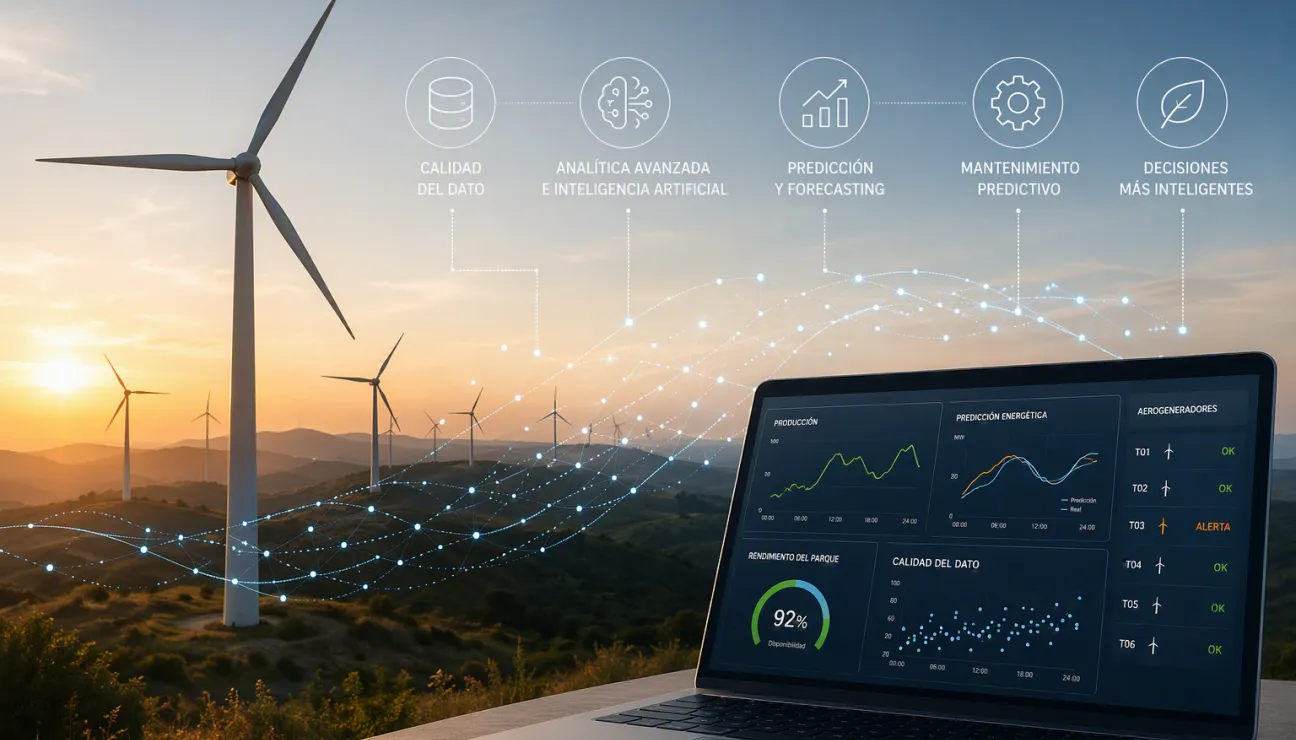
In a context marked by increasingly complex operations, the need to maximize renewable energy production, and growing pressure to optimize costs, advanced analytics and artificial intelligence are playing an increasingly important role. The sector is evolving from descriptive analysis models toward predictive and prescriptive approaches capable of anticipating behaviors, identifying improvement opportunities, and supporting increasingly sophisticated operational decisions.
Data Quality as the Starting Point
Every artificial intelligence strategy relies on one essential element: trustworthy data. As a result, one of the areas experiencing the most significant transformation is the processing and validation of operational information.
Traditionally, many of these processes relied on predefined rules or manual reviews. Today, more advanced models are emerging that can detect complex anomalies, identify inconsistencies, and reconstruct missing information by combining multiple data sources.
These capabilities are particularly relevant for critical variables such as wind speed, wind direction, and turbine power curves, where even minor inaccuracies can significantly affect performance assessments and downstream decision-making.
Better Understanding How Wind Turbines Perform
The availability of large volumes of operational data is also enabling the development of more accurate models to represent the real-world behavior of wind assets.
Multivariate approaches make it possible to analyze meteorological and operational factors simultaneously, providing more reliable estimates of energy production potential and a deeper understanding of the causes behind performance deviations.
Furthermore, the integration of explainable artificial intelligence techniques is helping these analyses move beyond simply identifying a problem to explaining why it occurs. This capability is especially valuable for operations teams, as it provides greater transparency and confidence in the results.
For example, a model may detect that a turbine is beginning to behave differently from the rest of the wind farm before a conventional alarm is triggered, allowing potential issues to be investigated at an earlier stage.
Forecasting Closer to Operational Reality
Energy forecasting is another area undergoing significant advancements.
Historically, many forecasting systems have relied primarily on meteorological information. However, experience shows that the actual performance of a wind farm is also influenced by its operational status: outages, temporary degradation, power limitations, or maintenance activities can all have a substantial impact on final energy production.
For this reason, new generations of forecasting models integrate not only weather variables but also recent operational information, resulting in predictions that more accurately reflect real operating conditions.
This evolution helps reduce uncertainty and improve planning for both operators and participants in energy markets.
From Corrective Maintenance to Failure Anticipation
Perhaps one of the most significant shifts is taking place in the field of operations and maintenance.
The combination of SCADA data, predictive models, and machine learning algorithms is enabling a transition toward condition-based maintenance strategies. Instead of acting only after a failure occurs or following fixed maintenance schedules, these approaches aim to identify early signs of degradation and estimate the future behavior of components.
This enables better prioritization of interventions, more efficient resource planning, and reduced operational costs and downtime.
At the same time, models designed to estimate the remaining useful life of key components are opening new opportunities for more efficient asset management and long-term strategic planning.
Integrating More Variables to Make Better Decisions
Wind farm operations are also evolving toward a more integrated approach, where decisions are no longer based solely on technical or economic variables.
Environmental factors are increasingly being incorporated into operational decision-support models. Among them, the management of interactions between wind farms and birdlife is gaining attention, with predictive technologies offering new tools to anticipate scenarios and adapt operations more effectively.
The ability to combine meteorological, operational, economic, and environmental information enables the development of more comprehensive decision-making models, better aligned with the challenges of the energy transition.
From Operating with Data to Operating with Intelligence
What is changing in the wind energy sector is not only how information is analyzed, but the very operating model itself.
While the past decade focused on digitalizing assets and collecting data, the next stage is about extracting value from that information through advanced models capable of anticipating events, reducing uncertainty, and supporting decision-making.
In this context, CIRCE is developing advanced analytics and artificial intelligence solutions for wind operational data, collaborating with operators and other stakeholders across the value chain to bring these capabilities into real-world operations.
Wind energy was one of the first industrial sectors to embrace digitalization at scale. Today, it faces a new transition: moving from having data to operating with intelligence. This evolution will enable more efficient wind farms, more resilient operations, and energy systems better prepared to tackle the challenges of an increasingly complex and dynamic environment.